Free HVAC Service Agreement Template (2026)
Here is a complete residential HVAC maintenance agreement you can adapt today — no email, no signup. It is an informational template, not legal advice: have a local attorney review it before you put it in front of customers.
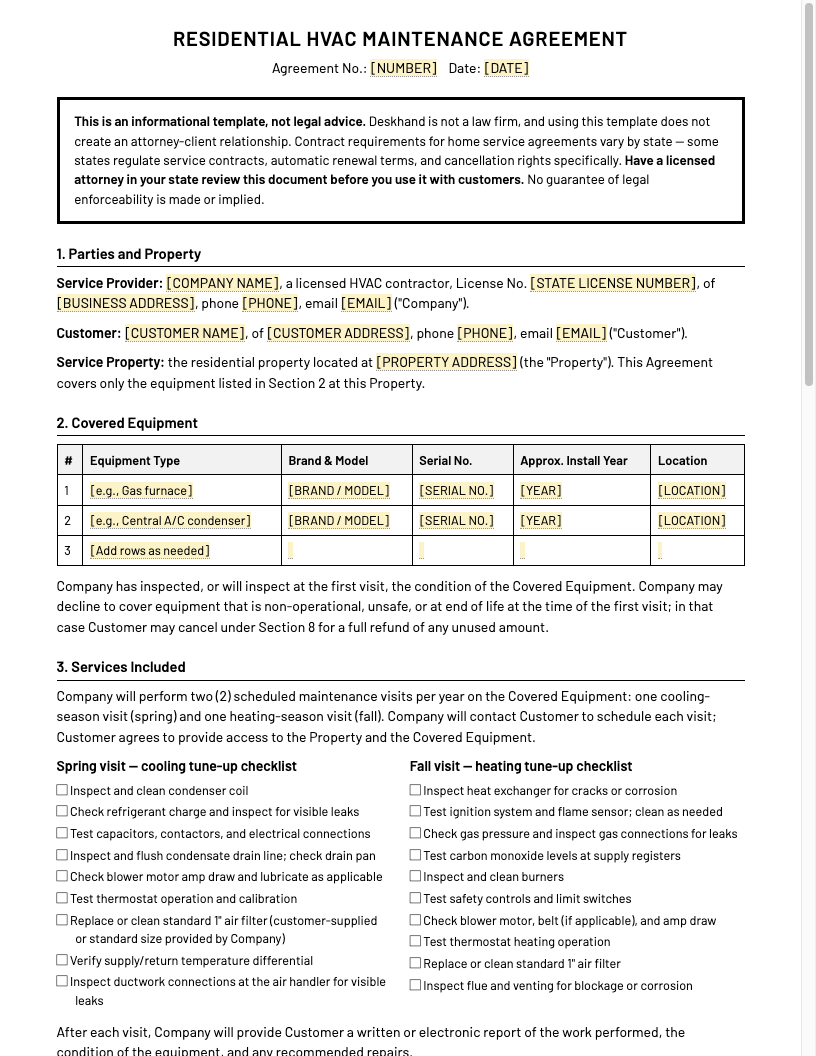
HVAC Service Agreement Template
Covered equipment, spring and fall tune-up checklists, pricing, renewal, and cancellation terms.
PDF · US LetterNo email required. Free to use in your business.
Running the paperwork is the easy part — Deskhand handles the office side for $49/month flat. Get early access:
How to use this template
The template above is a complete residential maintenance agreement — two tune-up visits a year, membership perks, pricing, renewal, and cancellation terms. To make it yours:
- Copy or download it, then replace every [BRACKETED] field with your own details: company info, license number, covered equipment, prices, notice periods.
- Choose your checkbox options. Section 5 asks you to pick a billing frequency (annual or monthly), and Section 7 asks you to pick a renewal mode (automatic or manual). Delete the option you don't use.
- Delete the optional lines you don't offer — for example, the no-overtime-surcharge benefit in Section 4 or the additional-systems pricing line in Section 5.
- Take it to a local attorney for a one-time review. A flat-fee review of a single document is a modest cost, and it covers every agreement you sign afterward. This matters more than it sounds: several states specifically regulate service contracts, automatic renewal disclosures, and cancellation rights.
- Reuse it forever. Once it's reviewed, this is your standard agreement. Make it e-signable so customers can sign at the kitchen table while you're still in the house — the close rate on "I'll email it to you" is a fraction of the close rate on "sign here."
One structural note: most solo shops should start with one plan. If you want tiers later, the standard pattern is a base plan (this template as-is) plus a premium tier that upgrades Section 4 — a bigger repair discount, all diagnostic fees waived, no overtime surcharge ever — and Section 3, with extras like a filter program or minor parts included up to a dollar cap. Edit those two sections to build the premium version rather than maintaining separate documents.
Why maintenance agreements matter for a solo HVAC business
A maintenance agreement is the only product a one-truck HVAC shop can sell that produces revenue while the phone isn't ringing. Everything else you sell requires a breakdown, a callback, or a referral to happen first. The agreement is money booked in advance.
The math is simple, and it compounds. Say you charge $199 a year: 50 agreements is $9,950 a year booked before a single service call comes in — roughly $829 a month you can count on. At 150 agreements it's about $29,850 a year. That's the difference between a dead January and a scheduled January.
The revenue is only part of it:
- Shoulder-season scheduling. The two visits land in spring and fall — exactly the slow seasons when a solo operator's calendar goes quiet. Agreements convert your worst months into planned, routed workdays.
- A repair pipeline. Every tune-up is a professional inspection of aging equipment. When the 14-year-old condenser finally needs replacing, you're the one standing in front of it with the customer's trust already earned. The value comes from presence, not from upselling junk — the agreement just guarantees you're present.
- Customer retention. An agreement customer has already decided who their HVAC company is. When something breaks in July, they don't Google "hvac repair near me" — they call the number on their agreement.
- Business value. A book of recurring agreements is a transferable asset. If you ever sell the business, predictable contracted revenue is what a buyer actually pays for.
How to price your agreement
All the numbers here are illustrative — plug in your own costs and rates. Start from what the agreement costs you to deliver: two visits at roughly 1.5 hours on-site each, plus drive time, is about 4 hours a year. At an illustrative fully-loaded target of $120 an hour, that's roughly $480 of your time delivered at retail value.
That's why agreements are priced at a discount to two à-la-carte tune-ups but above your true cost. Say your standalone tune-up is $149: two of them à la carte is $298, so the agreement typically lands around $199 to $279 a year. The gap between the agreement price and the à-la-carte price is justified by the membership benefits — priority service and the repair discount — not by cutting your margin.
Three rules of thumb:
- Never price below your cost to deliver both visits. An agreement that loses money on delivery doesn't get rescued by "exposure."
- The monthly framing sells better. "$20 a month" converts better than "$240 a year," even though it's the same money. Offer both; lead with monthly.
- The repair discount costs you nothing until it works. A 10% discount on a repair you would never have gotten is a customer acquisition cost, not a loss.
How to sell it on service calls
The close happens at the end of a repair call, at the moment of maximum trust — the system is running again, and you're the person who fixed it. The pitch writes itself: "Today's diagnostic fee was $89 — on the maintenance plan that's waived, and this repair would have been 10% off. It's $199 a year and I come out twice to keep this from happening again."
Three tactics that cost nothing:
- Put it on every invoice as a line item, offered and declinable. The customer sees the plan and its price every time you bill them.
- Apply today's diagnostic fee as a credit toward the first year. It reframes a sunk cost as a head start, and it makes signing today concretely cheaper than signing later.
- Mention the priority line. "Plan customers jump the queue in July" is the single most persuasive sentence in HVAC. Everyone has waited for AC service in a heat wave, or knows someone who has.
The template gets you the signature. The work starts after.
Every agreement you sell is two visits you have to remember to schedule, every year, forever — plus a renewal date, a billing schedule, and a customer who now expects you to call them. At ten agreements, that's a spreadsheet. At fifty, it's the exact evening paperwork the agreement business was supposed to prevent — and one forgotten spring visit is how an agreement customer becomes an ex-customer.
We're building Deskhand — so read this section knowing that — service call software for one- and two-person licensed trade shops, at $49 a month flat. Its recurring jobs feature exists for exactly this document: sell an agreement, and the spring and fall visits schedule themselves onto your calendar every year, with reminder texts to the customer, invoices generated on schedule, and everything synced two-way to QuickBooks.
The honest part: Deskhand hasn't launched yet. The template above is yours regardless — no email, no strings. If the software described here is what you've been looking for, join the early access list — founding members lock in $49 a month for life.